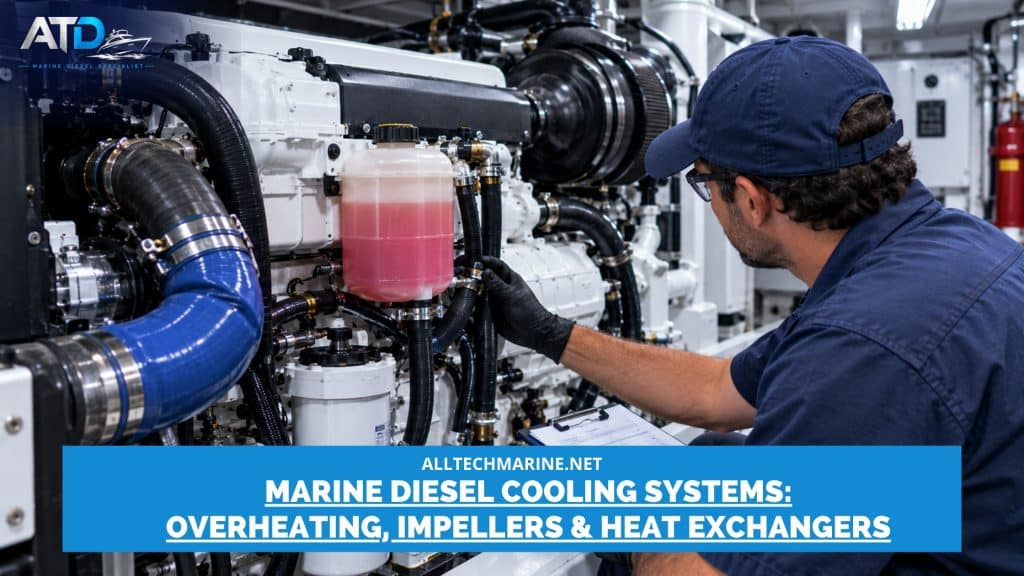
A marine diesel engine produces a tremendous amount of heat under load. Keeping that temperature under control requires a cooling system that can continuously transfer heat away from the engine while operating in a demanding saltwater environment.
Unlike most automotive cooling systems, marine diesel engines commonly use both a closed freshwater coolant circuit and a raw-water circuit that brings seawater into the vessel. Components such as the raw-water pump, impeller, sea strainer, heat exchanger, thermostat, coolant, hoses, and exhaust system all need to work together.
A problem with any part of that system can cause an engine to begin running hotter than normal or eventually overheat.
Understanding how the marine diesel cooling system works can help boat owners recognize developing problems before an overheat alarm turns into a more serious engine failure.
How Does a Marine Diesel Cooling System Work?
Most modern marine diesel engines use two interconnected cooling circuits.
The closed cooling circuit circulates coolant through the engine to absorb heat.
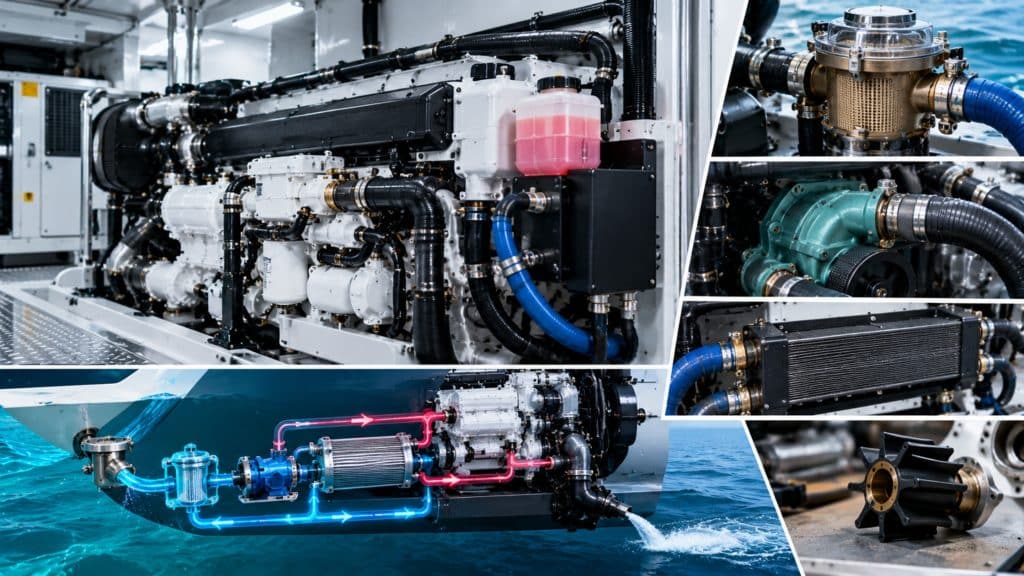
The raw-water circuit brings seawater into the boat and passes it through a heat exchanger, where it removes heat from the engine coolant without normally mixing directly with it. The warmed seawater is then typically discharged through the wet exhaust system.
A typical raw-water path may include:
- Through-hull intake
- Seacock
- Sea strainer
- Raw-water pump and impeller
- Heat exchanger
- Additional coolers, depending on the installation
- Exhaust mixing system
- Overboard discharge
Because cooling depends on adequate flow through this entire system, even a relatively small restriction can affect engine temperature.
ATD provides marine diesel cooling system service for overheating, raw-water flow problems, heat exchangers, impellers, and other cooling-system issues throughout Southwest Florida.
Closed Cooling vs. Raw-Water Cooling: What’s the Difference?
The two sides of a marine cooling system perform different jobs.
Closed Cooling System
The closed side contains engine coolant and operates in a loop through the engine.
It commonly includes:
- Coolant
- Circulation pump
- Thermostat
- Expansion or header tank
- Engine passages
- Heat exchanger
- Hoses
This side is similar in principle to an automotive cooling system.
Raw-Water Cooling System
The raw-water side uses seawater or lake water to remove heat from the closed cooling circuit.
It may include:
- Through-hull fitting
- Seacock
- Sea strainer
- Raw-water pump
- Flexible impeller
- Heat exchanger
- Oil or transmission coolers
- Exhaust components
The two circuits interact at the heat exchanger.
Instead of airflow across a radiator removing heat from engine coolant, raw water carries the heat away.
What Causes a Marine Diesel Engine to Overheat?
Marine diesel overheating can be caused by insufficient raw-water flow, restricted heat transfer, low coolant, thermostat problems, pump failures, damaged hoses, or other cooling-system issues.
Common causes include:
- Blocked raw-water intake
- Closed or partially closed seacock
- Clogged sea strainer
- Damaged raw-water impeller
- Failing raw-water pump
- Restricted heat exchanger
- Low coolant
- Coolant leak
- Faulty thermostat
- Damaged or collapsed hose
- Loose or damaged drive belt
- Restricted exhaust cooling-water flow
There can also be operating or mechanical conditions that contribute to excessive engine temperature.
Because several different failures can create the same symptom, an overheating problem should be diagnosed rather than assuming one particular component is responsible.
For a more focused troubleshooting discussion, see why a marine diesel engine may be overheating.
1. Blocked Raw-Water Intake
Cooling water has to enter the boat before anything else in the raw-water system can function.
Marine growth, debris, plastic bags, vegetation, or other material can obstruct the external intake.
A significant restriction reduces the amount of water available to the raw-water pump.
Depending on the severity, the engine may:
- Run warmer than normal
- Overheat primarily at higher RPM
- Produce reduced exhaust-water flow
- Trigger a temperature alarm
An intake restriction can sometimes appear suddenly, particularly if debris is pulled against the intake while underway.
2. Closed or Partially Closed Seacock
The raw-water seacock controls water flow through the hull fitting.
If it is closed, partially closed, obstructed, or damaged, adequate cooling water may not reach the engine.
This is one reason seacock position should be part of routine engine-room checks.
A seacock should also operate properly. A valve that is difficult to move, leaking, or corroded deserves attention rather than being ignored until an emergency.
3. Clogged Sea Strainer
The sea strainer helps prevent debris from reaching the raw-water pump and other cooling components.
As debris accumulates, water flow can become restricted.
Boat owners should inspect strainers regularly, particularly when operating in water containing:
- Seaweed
- Grass
- Floating debris
- Marine growth
- Sediment
A dirty strainer is relatively simple compared with many other cooling-system problems, but it can still cause an engine to overheat if water flow becomes sufficiently restricted.
Always follow safe procedures when opening or servicing anything connected to a below-waterline raw-water intake.
4. Damaged Raw-Water Impeller
The raw-water impeller is one of the most important maintenance items in the cooling system.
Flexible impeller vanes rotate inside the pump housing and draw water through the system.
Over time, the vanes can:
- Crack
- Harden
- Deform
- Tear
- Break completely
When an impeller deteriorates, raw-water flow can decrease.
A severely damaged impeller may stop moving enough water to cool the engine.
But there is another problem: broken impeller pieces don’t necessarily disappear.
Fragments can travel downstream and become trapped in heat exchangers, coolers, hoses, or other passages, creating additional restrictions.
Our knowledge base explains in more detail what happens when a marine raw-water impeller fails.
Replacing the impeller without accounting for missing pieces can leave part of the original problem inside the cooling system.
5. Restricted Heat Exchanger
The heat exchanger is where heat from the engine’s closed coolant circuit is transferred to raw water.
For that process to work efficiently, both adequate water flow and clean heat-transfer surfaces are required.
Over time, the raw-water side can accumulate:
- Scale
- Corrosion
- Salt deposits
- Marine growth
- Sediment
- Zinc debris
- Impeller fragments
As restriction or fouling increases, the heat exchanger becomes less effective.
The engine may initially operate normally at lower RPM but begin running hot under heavier load when more heat needs to be removed.
This is one reason a cooling problem may appear only when the boat is brought up to cruising speed.
Learn more about how to know if a marine heat exchanger needs cleaning.
6. Low Engine Coolant
Raw-water flow isn’t the only thing that matters.
The closed cooling system must contain the proper amount of coolant.
Low coolant can result from:
- External leaks
- Hose problems
- Loose connections
- Expansion-tank issues
- Heat-exchanger problems
- Internal leaks
- Previous service where the system was not filled or bled correctly
Repeatedly adding coolant without determining where it is going isn’t a solution.
If the coolant level continues dropping, the source of the loss should be identified.
Never remove a pressurized coolant cap from a hot engine. Hot coolant can be released under pressure and cause serious burns.
7. Thermostat Problems
The thermostat helps regulate coolant flow based on engine temperature.
A thermostat that isn’t operating properly can interfere with temperature regulation.
Depending on the failure, the engine may:
- Take too long to reach operating temperature
- Run cooler than expected
- Run hotter than expected
- Overheat
Thermostat problems are only one possible cause of abnormal engine temperature, so the cooling system should be evaluated as a whole.
8. Coolant Circulation Problems
The closed cooling circuit relies on circulation through the engine and heat exchanger.
Problems involving the coolant pump, drive belt, air trapped in the system, internal restrictions, or other components can reduce circulation.
Inspect belts for:
- Cracks
- Fraying
- Glazing
- Improper tension
- Missing material
Also look for signs of coolant leakage around pumps, hoses, connections, and the engine.
9. Damaged or Collapsed Hoses
Cooling-system hoses experience heat, vibration, pressure, saltwater exposure, and age.
They should be inspected for:
- Cracking
- Bulging
- Soft spots
- Hardening
- Chafing
- Leakage
- Loose clamps
- Corroded clamps
- Internal collapse
A hose can look acceptable externally while still having an internal problem.
Any significant restriction in a raw-water or coolant hose can reduce cooling performance.
10. Exhaust Cooling-Water Problems
On many marine diesel installations, raw water eventually enters the exhaust system.
That water helps cool exhaust gases and components before discharge.
Problems in this part of the system can affect cooling-water flow and may create additional concerns involving exhaust components.
Changes in exhaust-water discharge can therefore provide a useful clue.
Boat owners who know what normal exhaust-water flow looks like are more likely to recognize when something has changed.
Why Does My Engine Overheat Only at Higher RPM?
An engine that maintains normal temperature at idle but overheats at cruising speed or under heavy load often has a cooling system that can remove enough heat at low power but cannot keep up as engine load increases.
Possible causes include:
- Partially restricted raw-water intake
- Dirty sea strainer
- Worn impeller
- Restricted heat exchanger
- Reduced raw-water pump performance
- Cooling-system restriction
- Insufficient coolant circulation
Higher engine load produces more heat.
A marginal cooling system may therefore appear completely normal at the dock.
This is one reason troubleshooting an overheating problem may require evaluating the engine under realistic operating conditions rather than simply allowing it to idle.
Why Is My Marine Diesel Running Hot but Not Overheating?
A gradual increase in normal operating temperature can be an early warning.
For example, if an engine historically operates at a consistent temperature at cruise and begins running several degrees warmer under comparable conditions, something may be changing within the cooling system.
Possible causes include gradual heat-exchanger fouling, reduced raw-water flow, impeller wear, coolant problems, or another developing restriction.
Knowing the engine’s normal operating temperature is valuable because it establishes a baseline.
Don’t wait for the temperature gauge to reach the red zone before paying attention to a consistent change.
What Should You Do if a Marine Diesel Engine Overheats?
An overheating alarm should be treated seriously.
Continuing to operate an engine while it is overheating can result in significant damage.
Depending on the circumstances and engine manufacturer’s recommendations, appropriate steps may include:
- Reduce engine load.
- Monitor the temperature.
- Move to a safe location if possible.
- Shut the engine down when necessary.
- Allow the engine to cool.
- Check for obvious cooling-system problems.
- Avoid restarting the engine until you understand why it overheated.
Never remove a pressurized coolant cap while the engine is hot.
Also be careful around belts, pulleys, hot exhaust components, and moving machinery when inspecting an engine room.
For a more detailed guide, read what to do if a marine diesel engine overheats.
If the cause isn’t obvious or overheating returns after restarting, professional marine diesel engine diagnostics can help identify the underlying problem.
Marine Diesel Cooling System Troubleshooting Guide
| Symptom | Possible Areas to Inspect |
| Engine overheats rapidly | Raw-water intake, seacock, strainer, impeller, coolant level |
| Runs hot only under load | Heat exchanger, impeller, raw-water flow, coolant circulation |
| Little or no exhaust water | Intake, strainer, raw-water pump, impeller, restriction |
| Coolant level keeps dropping | Hoses, fittings, heat exchanger, pump, internal/external leaks |
| Temperature slowly increasing over time | Heat exchanger, raw-water restriction, impeller, coolant condition |
| Impeller has missing vanes | Downstream coolers, heat exchanger, hoses, passages |
| Overheating returns after repair | Remaining restriction or unresolved underlying problem |
These are troubleshooting directions rather than diagnoses. Several cooling-system problems can produce similar symptoms.
How Often Should a Marine Raw-Water Impeller Be Replaced?
There isn’t one replacement interval that applies to every engine and pump.
Follow the recommendations of the engine or raw-water pump manufacturer.
Operating conditions also matter.
Impellers can deteriorate due to:
- Age
- Heat
- Long periods of inactivity
- Running dry
- Debris
- Pump wear
Don’t wait for the impeller to fail before thinking about replacement.
The relatively low cost of preventive impeller service is one reason it should be part of regular marine diesel engine maintenance.
How Often Should a Marine Heat Exchanger Be Cleaned?
Heat-exchanger service intervals vary based on the engine manufacturer, installation, operating environment, and cooling-system condition.
Instead of applying a universal schedule to every engine, consider:
- Manufacturer recommendations
- Engine operating temperature
- Raw-water conditions
- Previous service history
- Visible deposits or corrosion
- Changes in cooling performance
An engine that begins operating warmer under load may warrant inspection even if a predetermined service interval hasn’t been reached.
Marine Cooling Systems in Southwest Florida
Cooling-system maintenance is particularly important for boats operating in Southwest Florida.
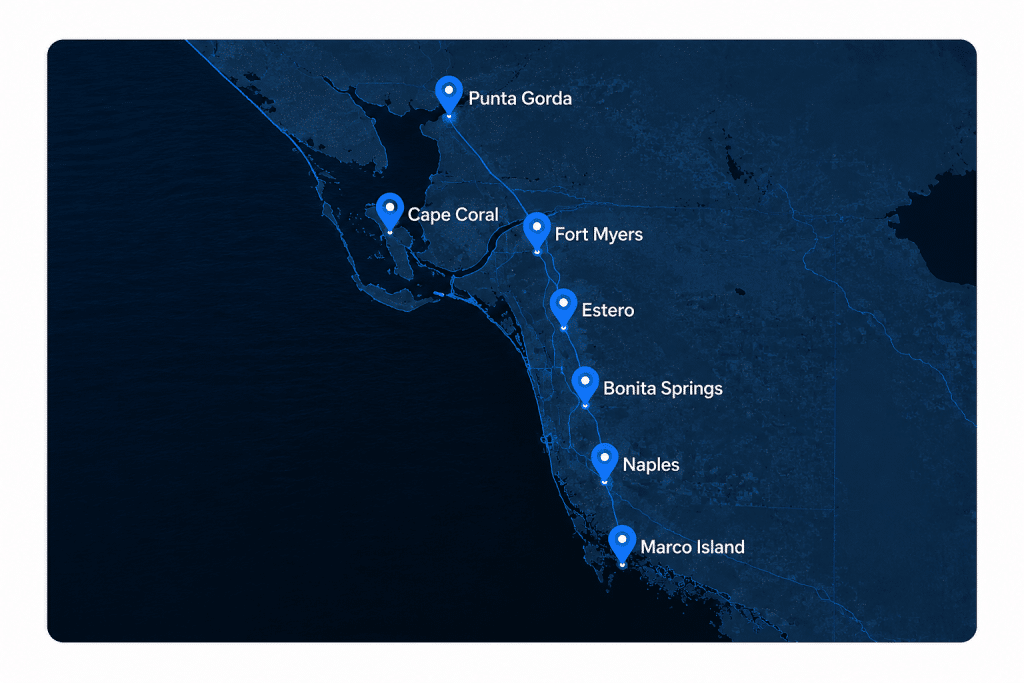
Vessels around Naples, Marco Island, Bonita Springs, Estero, and Fort Myers routinely operate in warm saltwater environments.
Raw-water cooling components are exposed to conditions that can contribute to:
- Salt deposits
- Marine growth
- Corrosion
- Scale
- Debris
- Deterioration of cooling-system components
Boats that sit unused for extended periods aren’t necessarily protected from these problems. Age, corrosion, marine growth, and impeller deterioration can continue even when engine hours remain low.
This is one reason cooling-system inspection should remain part of preventive maintenance regardless of how frequently the vessel is used.
Preventing Marine Diesel Overheating
A good overheating-prevention strategy focuses on maintaining water flow and heat transfer.
Boat owners should:
- Monitor normal engine temperature
- Inspect raw-water strainers
- Verify seacock operation
- Replace impellers at appropriate intervals
- Inspect belts and hoses
- Maintain proper coolant level
- Use the correct coolant
- Service heat exchangers as needed
- Watch exhaust-water flow
- Investigate unexplained coolant loss
- Address gradual temperature changes
- Follow manufacturer maintenance schedules
Most importantly, don’t normalize a temperature problem.
If the engine is running hotter than it used to, determine why.
Frequently Asked Questions About Marine Diesel Cooling Systems
What is the most common cause of a marine diesel engine overheating?
There is no single cause that applies to every overheating engine. Common problems include restricted raw-water flow, clogged strainers, damaged impellers, heat-exchanger restrictions, low coolant, thermostat problems, pump issues, and damaged hoses. Diagnosis should identify where cooling performance is being lost.
How do I know if my marine diesel impeller is bad?
A damaged impeller may cause reduced raw-water flow, increased engine temperature, or overheating. Physical inspection may reveal cracked, hardened, deformed, or missing vanes. If pieces are missing, downstream cooling components should be checked for impeller fragments.
Can a dirty heat exchanger cause overheating?
Yes. Scale, corrosion, marine growth, debris, and other deposits can restrict raw-water flow or reduce heat transfer through the heat exchanger. The engine may run normally at low load but overheat as engine load and heat production increase.
Why does my marine diesel overheat at cruising speed but not at idle?
A partially restricted cooling system may remove enough heat at idle but be unable to handle the increased heat produced under load. Possible causes include a restricted heat exchanger, worn impeller, blocked intake, dirty strainer, or another raw-water or coolant-flow problem.
Can I keep running my boat if the engine is overheating?
Continuing to operate an overheating engine can cause serious damage. Follow the engine manufacturer’s procedures, reduce load or shut the engine down when appropriate, and determine the cause before continuing normal operation. Never open a pressurized cooling system while the engine is hot.
Need Marine Diesel Cooling System Service in Southwest Florida?
An overheating marine diesel engine shouldn’t be treated as normal. Whether the problem involves a raw-water impeller, heat exchanger, coolant leak, restricted water flow, thermostat, hose, or another component, identifying the cause early can help prevent more serious engine damage.
ATD Marine Diesel Specialist provides mobile marine diesel cooling-system diagnostics, maintenance, and repair throughout Naples, Marco Island, Bonita Springs, Estero, Fort Myers, and surrounding Southwest Florida waters.
If your engine is running hotter than normal, repeatedly overheating, or showing signs of reduced cooling-water flow, ATD can inspect the cooling system and determine what needs attention.